Every day a finished unit could be leased and isn’t, you’re losing rent. But a fast turn that misses things costs money too, in callbacks, complaints, and the next resident’s first impression. A good make-ready checklist is how you get both speed and consistency, no matter who’s doing the work.
Every landlord and manager has different standards, so treat this as a starting point. It’s close to what our average turn looks like, and you can use it to write your own scope or to check a vendor’s.
Key takeaways
- Walk the unit and write the scope before you schedule anything.
- Check the usual mold hotspots on every turn, not just when someone complains.
- Test every appliance after cleaning it, so a leak shows up now and not after move-in.
- Flooring and fine cleaning come late, so other trades don’t damage finished work.
Before the work starts
- Walk the unit as soon as you can after move-out, and take photos for your records.
- Write down repairs, and decide what gets replaced and what gets cleaned.
- Note the move-in date, and work backward from it.
- Confirm keys and access, and get utilities on so the crew can test everything.
Clear it out and clean it
- Trash out the unit, including closets, cabinets, and any storage or balcony.
- Deep clean the carpet if it’s staying.
- If odors linger, treat the air (we use ozone or hydroxyl), then change the air filters.
Repairs and paint
- Patch and repair drywall. On textured walls and ceilings, match the texture.
- Paint the walls if they need it. A consistent color and product across a property makes touch-ups easier on the next turn.
- Take care of pest control and the miscellaneous repair list.
- Check doors, locks, window screens and blinds.
- Test smoke alarms, and check fire extinguishers where the property has them.
Check for moisture
Look closely at the usual hotspots for mildew and mold, especially near sinks and windows. If you find something, treat it and find out why it’s there before the next resident moves in. We go into that in why mold keeps coming back in rental units.
Bathrooms
- Deep clean and sanitize the tub or shower, toilet, vanity and floor.
- Look at caulk and grout, and replace failed caulk.
- Run the fan and make sure it actually moves air.
- Check under the sink for leaks and soft spots.
Kitchen
- Clean cabinets inside and out.
- Clean and sanitize the countertops.
- Move appliances where you can, and clean under and behind them.
- Clean and disinfect every appliance, then test each one to make sure it works and doesn’t leak.
Flooring and final walk
- Replace or repair flooring as scoped: carpet, LVP or patches.
- Do a final clean to catch the dust from the other trades.
- Stripe the carpets on the way out, so they look new when the unit’s shown.
- Walk the finished unit against the original scope, and take photos of it.
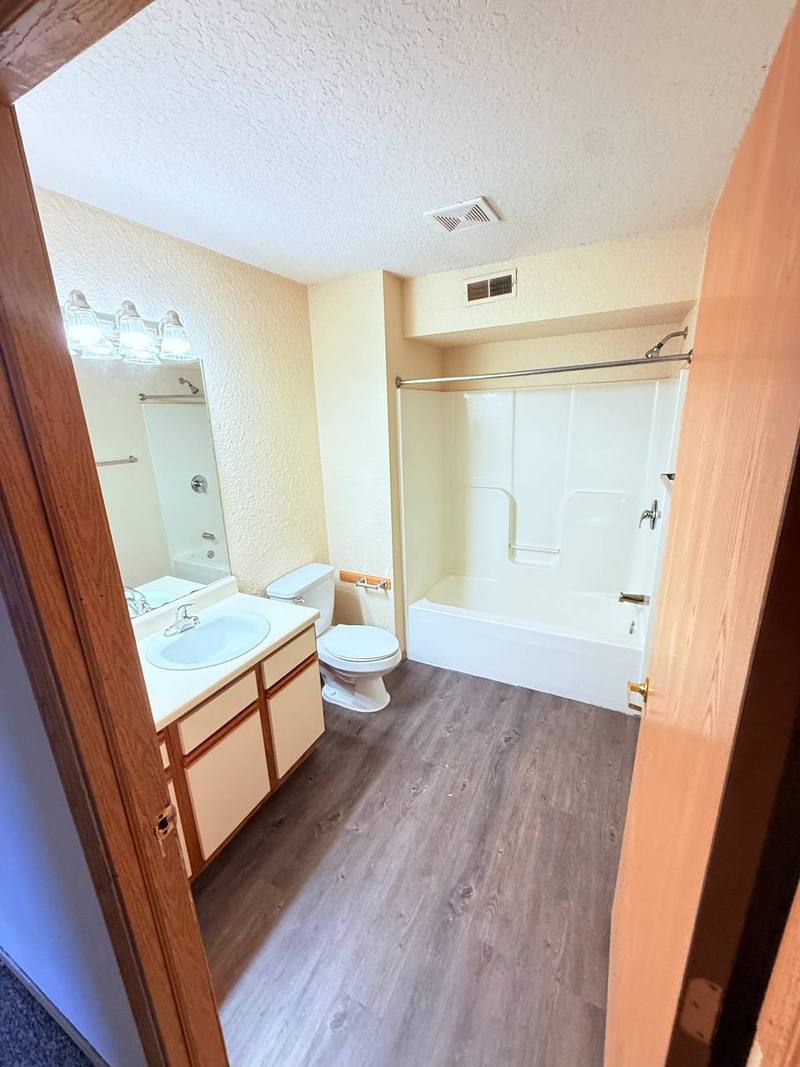
A finished bathroom on one of our Charleston apartment turns, with new vinyl plank flooring.
What a turnover costs
It varies by location, property and what needs doing. As a rough ballpark, we see $0.50 to $5 per square foot. Light cleanings and basic maintenance may be as low as $250, and full remodels with new carpet, paint and appliances may be $5,000 or more.
The things that move that number the most:
- Whether the carpet gets cleaned or replaced
- Whether the whole unit needs paint, or just touch-ups
- Appliance replacements
- Damage beyond normal wear, and any moisture problems you find along the way
- How fast it has to be done
More on that in how much a tenant turnover costs.
Why one crew helps
A lot of turn delays happen in the gaps between trades: the painter waits on the drywall repair, and the carpet installer waits on the painter. When one team handles the cleaning, repairs, paint and flooring, there are fewer handoffs to schedule.
We do turns on single units and on full portfolios, from Mattoon and Charleston to Shelbyville, Decatur and Champaign-Urbana. If you have units coming open, tell us your unit count and timeline and we’ll follow up.